

TEHRAN, May 4 – As uncertainty looms about whether or not the Iran-US ceasefire will hold, Iran’s air force carried out some of its most daring operations yet. Much of these operations occurred in the opening days of the month-and-a-half-long “Ramadan War”, also referred to as “Special Combat Operation Epic Fury” by the United States, or simply, the Iran War.
Operations over Kuwait
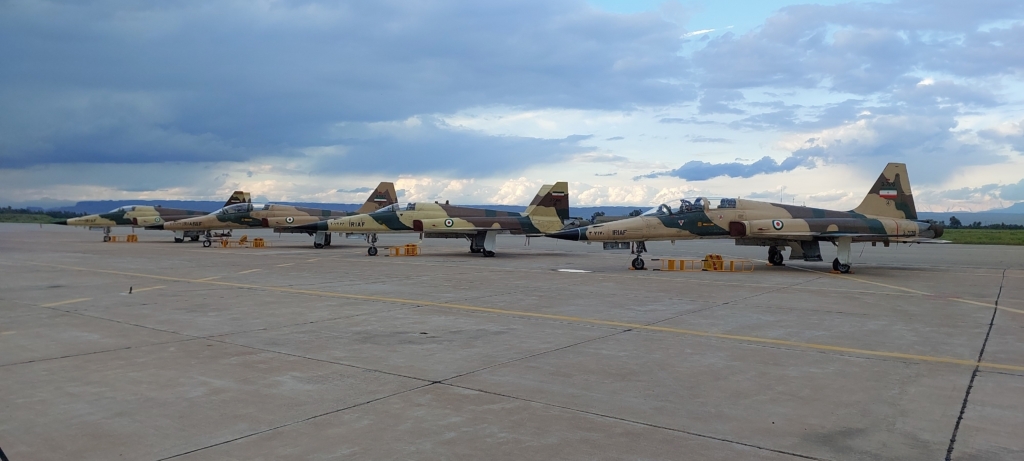
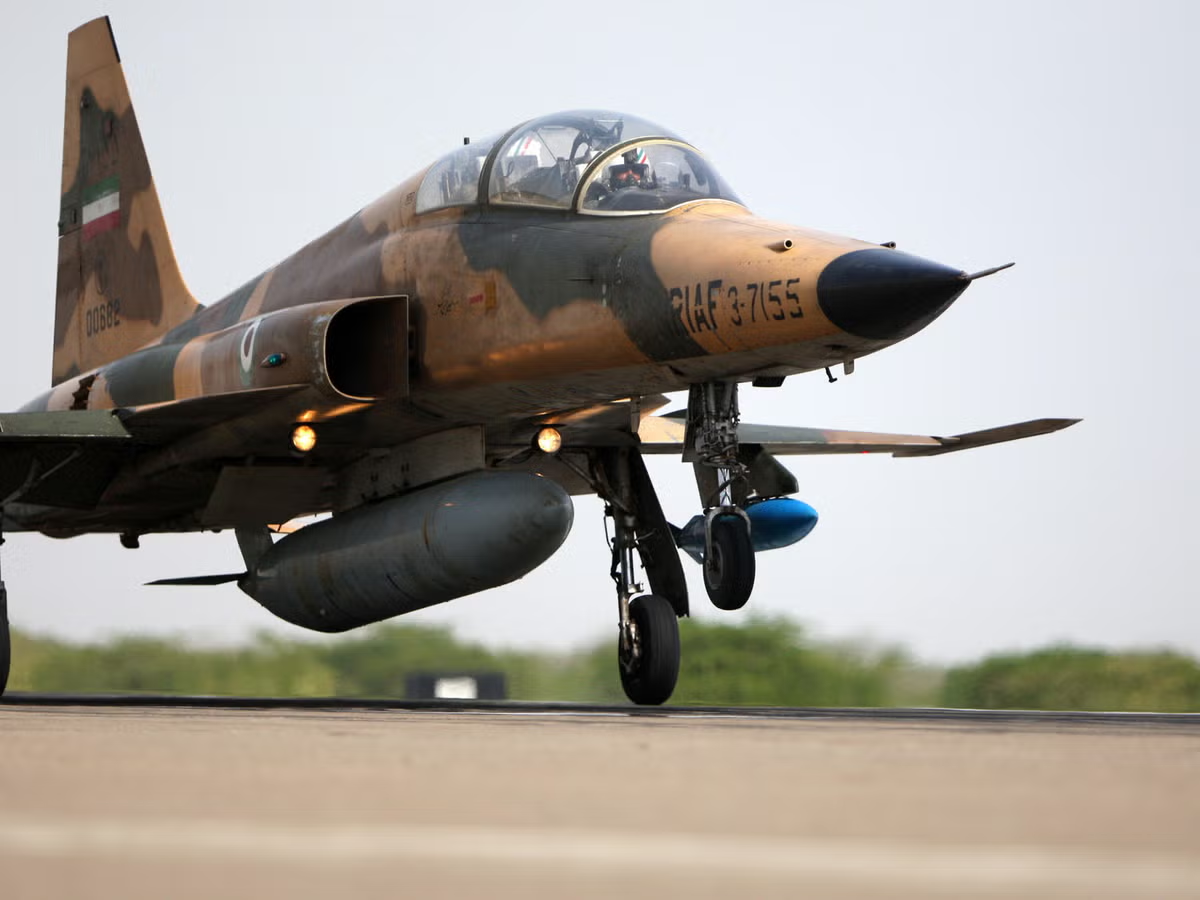
NBC News dropped a bombshell article on April 25, 2026, that Iran had caused “much more extensive damage to US bases” than publicly known. Within this report, it included a mention that a pair of Iranian F-5s bombed the US base at Camp Buehring. The two jets managed to get away unscathed and return to base despite the heavy presence of US air defenses and air patrols in Kuwait.
What is not mentioned, however, is that online OSINT observers had managed to figure out some weeks ahead of the NBC report that some kind of Iranian air force attack had occurred. This was through spotting an unexploded “dumb” (unguided) FAB-500 bomb in photos of damage in Camp Arifjan in Kuwait. The bomb is speculated to be a FAB-500 m.62, which is used by the Iranian air force. Furthermore, CENTCOM’s very brief acknowledgement of “Iranian aircraft” attacks over Kuwait during the F-15E triple shootdown incident, for which it blamed “friendly fire” by Kuwaiti air defenses in the same statement.
On April 28, Iran’s army spokesman, Brigadier General Mohammad Akraminia, confirmed that Iran’s Air Force conducted sorties to strike US bases in Iraq, Kuwait, and Qatar early in the war.
The details of the Iranian F-5 strike on Camp Buehring are unknown. It is also unknown what type of F-5 model Iran was using.
The original F-5 (a second-generation fighter jet) was designed in 1959 by the US’s Northrop Corporation, whereas the heavily modified/upgraded F-5E Tiger II aircraft (a third-generation fighter jet) was designed in 1970. The F-5E variant was delivered to Iran during the Shah’s armaments buildup in the 1970s.
Despite the aircraft’s advanced age and US technical support being cut off since Iran’s 1979 revolution, Iran has kept much of its remaining F-5 fleet intact. Initially, it was through smuggling parts or cannibalizing airframes, but eventually by reverse engineering and manufacturing local spare parts. Furthermore, Iran has also locally upgraded its F-5Es to the HESA Kowsar standard, which entered mass production in 2018. The Kowsar’s upgrades include modernized avionics, digital cockpit, heads-up display, and other features, bringing the aircraft up to many fourth-generation fighter standards. Other F-5E variants produced by Iran include the Saegheh and the Azarakhsh.
The aircraft likely managed to pull off the attack by flying low and hugging the Earth to evade radar detection, taking advantage of the Earth’s curvature, natural features such as hills and mountains, the F-5’s small radar cross-section, and using the diversionary cover of Shahed-136 drones and ballistic missiles. Through these factors, the Iranian air force would be able to achieve the element of surprise, with US forces being unable to detect the aircraft until it is too late, a minute or less away from the target. Iranian strikes against US radomes and other early warning infrastructure also may have played a role in blinding and making the bases more susceptible to Iranian air attack.
Regardless, the mission was extremely dangerous, a Top Gun mission impossible style mission where the chance of success was small and the likelihood of returning safely to base was low. Yet against the odds, the Iranian pilots achieved what many deemed impossible.
It is unknown if any other attacks occurred, and how many. There are allegations of Su-24 attacks on Camp Arifjan being responsible for the dumb bomb seen in damage there. Regarding the triple F-15E shootdown incident in the opening phase of the Iran War, there are also doubts amongst observers. The official narrative peddled by CENTCOM is that Kuwaiti air defenses shot down the three F-15s in a massive friendly fire incident. However, one video emerged of what might grainily appear to be a Kuwaiti F/A-18 downing one of the three F-15Es, leading to a “Ghost of Kuwait” mythology being made, as well as conspiracy theories of an “Iranian sleeper agent.” The Wall Street Journal also reported that a Kuwaiti F/A-18 shot down all three F-15E’s. The aforementioned acknowledgement of “Iranian aircraft attack” by CENTCOM has, however, led some online to speculate that an Iranian F-5 variant could be misidentified as a Kuwaiti F/A-18. There is also other unsupported speculation of Iranian F-14s or MiG-29s being responsible for the F-15 shootdowns. Whatever the truth may be, we don’t know and likely won’t for a long time.
Operations over Qatar
Early in the war, on March 2nd, Qatar’s Ministry of Defense reported in a press release that Qatari F-15s downed two Iranian Su-24 attack aircraft less than two minutes away from striking the US base in Al Udeid, one of the largest in the world. The aircraft were flying very low (24 meters
Al Jazeera confirmed the account a month later in April, releasing a documentary on the extensive damage to US bases and energy infrastructure in Qatar, showcasing a tailpiece and a few other aircraft parts salvaged from the Su-24 wreckages.
Insider sources within the Iranian and Qatari militaries have confirmed anonymously to RTSG News that two Iranian pilots gave their lives for the mission, whereas two survived and were rescued back to Iran, albeit very severely injured.
It is possible that, despite being shot down, the Iranian aircraft achieved their objectives depending on their loadout. Iran’s Su-24s are capable of firing various air-to-ground and cruise missiles, including many with fire-and-forget capability. Options include the Hoveyzeh and Asef, who modified clones/variants of the Russian Kh-55 cruise missile; Kh-31 (AS-17 Krypton), a fire-and-forget radar-seeking/radiation-seeking missile, perfect for hitting US air defense assets; and lastly the Kh-29MP, another fire-and-forget radar-homing missile. All of these missiles are capable of being fitted onto Iranian Su-24s.
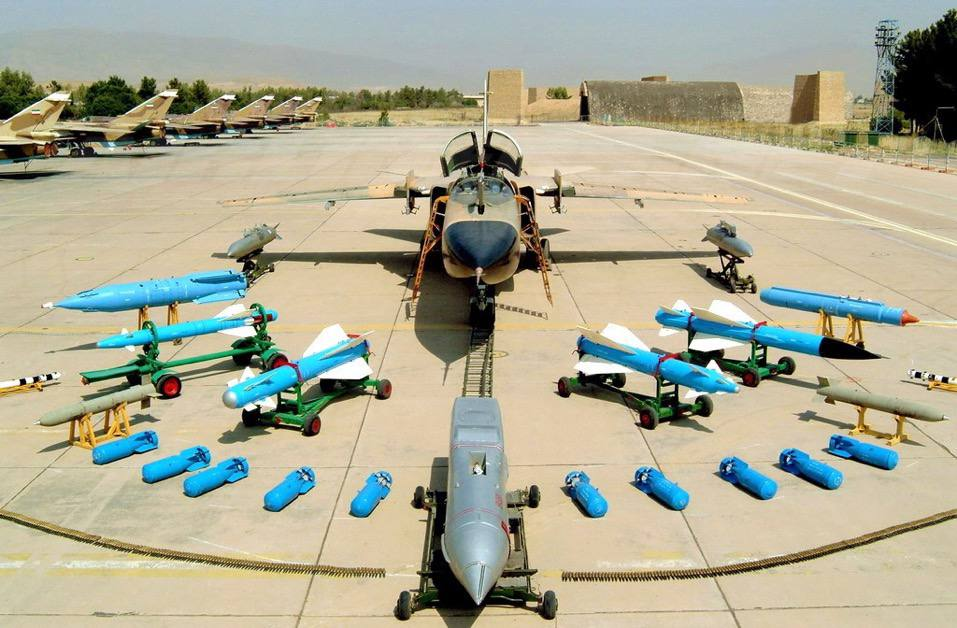
If these fire-and-forget missiles were not part of the Su-24 loadout for the Qatar mission, it is unlikely that the Iranian Air Force hit its objectives in this mission.
The Su-24 was originally designed in the 1960s by the USSR. The Su-24M upgrade was made in 1983, and exported to a number of countries, such as Saddam Hussein’s Iraq, in the Su-24MK form. Iran would acquire 24 Su-24MKs in 1991 when the Iraqi Air Force fled into Iran to escape the US during Desert Storm. Iran would acquire an additional 12 Su-24MKs from Russia between 1991 and 1993. As of 2024, Iran reportedly had 29 Su-24MKs in active service.
Operations over Iran
Iran’s air force has been spotted flying over Iran despite claims of US and Israeli “air supremacy” over Iran. Iran’s air force was carrying out interceptions of US and Israeli drones and standoff munitions/cruise missiles. This includes intercepts of US JASSM missiles and others. Some Iranian jets sighted over the war include F-4 Phantoms, MiG-29s, and Yak-130 trainer aircraft.
The only Iranian aircraft to be shot down over Iran during the war was a Yak-130 trainer aircraft. The aircraft was shot down by an Israeli F-35 while it was carrying out interceptions of US/Israeli standoff munitions over Tehran. This was the first and only kill achieved by any F-35 aircraft since its introduction to various air forces.
Aside from the Yak-130 shootdown and the two Su-24s shot down by Qatar, all other Iranian aircraft losses in the war were on the ground – likely being grounded, cannibalized, unairworthy, or decoy airframes not in active service. The following Iranian aircraft were damaged or destroyed on the ground:
- 10 Chengdu J-7
- 5 Il-76 transports
- 3 An-74 transports
- 3 F-14 Tomcats
- 3 C-130 Hercules
- 2 Fokker F-27 Friendship
- 2 F-5
- 2 Su-22
- 1 Su-24
- 1 Bell 214
- 1 F-4 Phantom II
This, combined with the three aircraft shot down, leads to a total loss of around 35 Iranian airframes, damaged or destroyed. Note that the US-Israel-Gulf alliance is estimated to have lost between 89 (conservative) to 103 (upper end) airframes due to Iranian strikes or air defense shootdowns.
After the war, Iranian aircraft were seen flying, such as F-4 Phantoms and MiG-29s. This includes escorting the plane of Pakistani general Asim Munir during his visit to Iran.

In sum, the early air phase of the conflict underscores a central paradox: despite technological inferiority, a gigantic military budget gap, and decades of sanctions, Iran’s air force demonstrated an ability to execute high-risk, low-altitude strike operations that challenged assumptions of uncontested U.S. and Israeli air dominance. From the audacious F-5 sorties over Kuwait to the costly but determined Su-24 mission toward Qatar, these operations reveal a doctrine built on surprise, improvisation, and calculated sacrifice. These missions are worthy successors to Iran’s other air force masterstroke – the attack on H3 in 1981.
At the same time, the fog of war—conflicting reports, OSINT speculation, and official ambiguity—leaves many of the war’s most dramatic episodes unresolved.
What is clear, however, is that the conflict has exposed vulnerabilities and reshaped perceptions of capability, signaling that even legacy platforms, when used creatively by determined pilots, can still play a decisive role in modern warfare.
Written by Ruslan


Leave a Reply